

Health Law Daily Wrap Up, TOBACCO—5th Cir.: Informal adjudication of FDA ‘comparative efficacy standard‘ for e-cigarettes violated APA due process, (Aug 27, 2026)
Law Firms Mentioned:Keller & Heckman, L.L.P.
Organizations Mentioned:Keller & Hackman, LLP | NicQuid, L.L.C. | U.S. Department of Justice
By Justin Marcus Smith, J.D.
The nominal process of adjudication could not conceal or excuse secretive development of a prospective policy.
The Food and Drug Administration (FDA) “comparative efficacy standard” applied to electronic nicotine delivery systems (ENDS) was a substantive rule that required Administrative Procedure Act (APA) notice-and-comment rulemaking, held the U.S. Court of Appeals for the Fifth Circuit. The court held that FDA v. Wages & White Lion Investments, L.L.C. foreclosed the menthol e-cigarette petitioner’s contention that application of the comparative efficacy standard was arbitrary and capricious. Wages held the FDA did not unlawfully change its position about what information must be included in a PMTA when applying the comparative efficacy standard to PMTAs for “dessert-flavored” vapes. The instant court also held that VDX Distro, Inc. v. FDA foreclosed the question of whether the comparative efficacy standard was a “tobacco product standard” within the TCA definition and whether it required notice-and-comment rulemaking. The Supreme Court in Wages and the instant court in VDX Distro had specifically reserved rulings on APA notice-and-comment rulemaking, but the Fifth Circuit now held, on due process grounds, that the comparative efficacy standard was a substantive rule requiring APA notice-and-comment. The court vacated the challenged FDA order without reaching the question of whether the FDA was arbitrary and capricious in applying the comparative efficacy standard to NicQuid’s menthol, tobacco-flavored or zero-nicotine products. On remand, the court directed the FDA to either rethink the rule, re-adopt it consistently within APA notice-and-comment so that everyone could contribute to rational and sound policy, or else undertake other appropriate proceedings consistent with the court’s opinion (NicQuid, L.L.C. v. FDA, No. 25-60369 (5th Cir. Aug. 19, 2026)).
Background. NicQuid, LLC, a maker of electronic nicotine delivery systems (ENDS), and Wood Creek Vapory, a retailer of vaporized-nicotine related products (collectively, petitioners), challenged the FDA denial of a NicQuid premarket tobacco product application (PMTA).
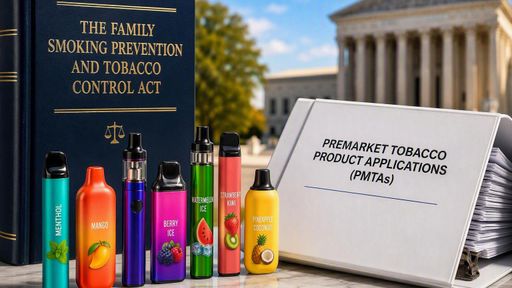
The Family Smoking Prevention and Tobacco Control Act (TCA) prohibited the marketing of new tobacco products without authorization from the FDA. It also provides that FDA “shall deny” a new PMTA unless the applicant shows the product would be “appropriate for the protection of the public health” (APPH standard). 21 U.S.C. § 387j(c)(2)(A).
In 2024, the FDA denied NicQuid’s PMTA under the FDA’s “comparative-efficacy standard.” The FDA marketing denial order (MDO) said NicQuid products, which were menthol-flavored, did not qualify as APPH because the PMTA did not show sufficient evidence of a benefit for adult users outweighing the risk to youth users. FDA specifically noted the NicQuid PMTA lacked any Randomized Control Trial, longitudinal cohort study, or other evidence of switching behavior by adults. FDA acknowledged PMTA inclusion of cross-sectional surveys, but it rejected them as not specific to NicQuid products and also for purportedly not evaluating outcomes based on flavor type to enable comparisons between tobacco and other flavors. The FDA contended its denial complied with FDA v. Wages & White Lion Investments, L.L.C., 604 U.S. 542 (2025) (Wages) (see Supreme Court sides with FDA, e-cigarette manufacturers lose flavor expansion efforts, Apr. 2, 2025), reversing Wages and White Lion Invs., L.L.C. v. FDA, 90 F.4th 357 (5th Cir. 2024) (en banc) (see FDA’s ‘regulatory switcheroos’ sour Fifth Circuit support for flavored nicotine product ban, Jan. 5, 2024).
The FDA had received many PMTAs before the September 2020 PMTA deadline for ENDS products already on the market after the FDA adopted a rule, in 2016, making it unlawful to market new ENDS without FDA authorization. FDA based its crackdown on cartridge-based e-cigarettes in sweet and appealing flavors on perceived greater risks to youth. However, the FDA conversely saw the same products might benefit habitual smokers if they switched to vaping.
FDA generally applied an APPH analysis considering many factors to PMTAs, but it refused to create criteria that all products must satisfy, cleaving instead to individualized assessments of tobacco product risks and benefits based on the contents of PMTA applications. In contrast to the call for more studies in the NicQuid MDO, FDA guidance suggested PMTAs would probably not need clinical or other studies on comparative health risks of ENDS versus existing products. FDA guidance on flavored products added that flavored ENDS review would apply to products other than tobacco-flavored and menthol-flavored ENDS and that it would separately address PMTAs for menthol-flavored ENDS due to unique considerations.
The petitioners asserted that FDA application of the comparative efficacy standard, as evident in the marketing denial order (MDO) itself and two internal agency memoranda mandating the “comparative efficacy study requirement” for all PMTAs, was arbitrary and capricious or otherwise violated due process. The petitioners posited that the comparative efficacy standard counts as a substantive standard under governing principles of administrative law. They argued the FDA adopted it in circumvention of the statutory notice-and-comment rulemaking procedure in the TCA or in violation of the foundational notice-and-comment rulemaking requirements of the APA. They further maintained that FDA failed to give NicQuid fair notice of its change in position on the comparative efficacy analysis and enforcement policy for menthol-flavored products.
Venue. The court held that venue in the Fifth Circuit was appropriate even though NicQuid had its principal place of business outside the circuit. There was no need for each petitioner to independently establish venue under the TCA. Venue was appropriate for all petitioners if it was appropriate for one. National Association of Private Fund Managers v. SEC, 103 F.4th 1097 (5th Cir. 2024).
The FDA analogized to Trump v. CASA, 606 U.S. 831 (2025), suggesting that the equitable relief of APA vacatur and remand should be limited to that necessary to redress a plaintiff’s injury, but the court held CASA did not change the result. CASA distinguished between traditional and “universal” injunctions, but NicQuid was actually present in the administrative action seeking vacatur and remand, which were equitable remedies the APA authorized.
APA rulemaking. The court held the FDA “sidestepped” APA notice-and-comment rulemaking. The policy to reduce youth access to e-cigarettes might be sound, but APA procedural safeguards are intended to promote informed, rational decision-making by administrative agencies. The court said agency free choice under SEC v. Chenery Corp., 332 U.S. 194, 202–03 (1947) (Chenery II) to use adjudication should not be used to evade APA procedural safeguards.
The court noted here that VDX Distro, Inc. v. FDA, 179 F.4th 356, 360 (5th Cir. 2026) already overruled the petitioners’ theory that the comparative efficacy standard amounted to a statutorily defined “tobacco product standard,” (see FDA denial of menthol e-cigarette application upheld under comparative-efficacy framework, Jun. 26, 2026) but the petitioners continued to press it. The petitioners’ central argument was that the comparative efficacy standard amounted to a substantive rule requiring notice-and-comment rulemaking. Whereas FDA allegedly issued MDOs for over 1.2 million flavored ENDS, it only approved four menthol-flavored closed-system ENDS. In total, FDA received applications for over six million ENDS products but only approved 45 of any kind.
Substantive rule. The APA defines a “rule” as an “agency statement of general or particular applicability and future effect designed to implement, interpret, or prescribe law or policy.” 5 U.S.C. § 551(4). Whether a rule is substantive turns on whether the agency intends to bind itself to a particular legal position.
The Fifth Circuit said it knew, under Circuit precedent, that the comparative efficacy standard amounted to a substantive rule. First, it affected the rights of broad classes of unspecified individuals. The numerosity of over one million MDOs, applying to more than six million products, was persuasive. The contrast between the FDA granting applications that satisfy the comparative efficacy standard but denying many thousands that did not have one underscored that the FDA was determining the rights and obligations of parties. The breadth of the FDA’s application of the standard, affecting property rights and commercial interests, implicated due process.
Second, an action is binding if it is facially binding, is applied in a way that indicates it is binding, or retracts discretion to adopt a different view of law. The comparative efficacy standard, as revealed in a 2021 memo, and lately raised again in draft guidance, appeared to be binding on FDA staff; was applied to more than one million MDOs for non-tobacco flavored ENDS as though binding; and impacted the rights of numerous applicants.
Third, the court said it knew the FDA developed and applied the policy prospectively based on various memos. The FDA did not develop its adjudicatory position in an adjudication. Nor did it retroactively determine that a party violated a policy. Instead, 2022 internal memoranda “developed a prospective policy behind closed doors, with heavy-handed experts far away from the hoi polloi, which FDA then began to apply in adjudications.”
Chenery II inapplicable. The FDA urged it had discretion to choose between rulemaking and adjudication, but the Fifth Circuit said it doubted the agency could use adjudication to promulgate a rigid, across-the-board requirement or use informal adjudication to promulgate a substantive rule. The risk of flavored ENDS to youth was not a problem FDA could not have foreseen. The FDA also approved 45 ENDS, so whatever inexperience it may have had, the comparative efficacy rule was now a “hard and fast rule” that was the antithesis of the flexible and fluid “tentative judgment” Chenery II contemplated. Uniform use of the comparative efficacy rule to assess millions of applications belied any notion of the impossibility of formulating a general rule.
Even if Chenery II allowed FDA to adopt the comparative efficacy rule by adjudication, the agency still could not adopt it by informal adjudication. The MDOs denying licenses to market particular products were quintessential informal adjudication. If an agency is going to act with the force and effect of law, it must use notice-and-comment rulemaking or formal adjudication, not one-off informal adjudications native to idiosyncratic facts.
Conclusion. The Fifth Circuit, applying the existing and undisturbed law of R.J. Reynolds Vapor Co. v. FDA, 65 F.4th 182, 192–94 (5th Cir. 2023) (see Stay granted pending review of denial of application to market e-cigarettes, Mar. 28, 2023) pertinent to APA due process concerns, within the carveouts of the Supreme Court in Wages and this court in VDX Distro, held the FDA comparative efficacy standard amounted to a substantive rule. Adoption through informal adjudication contravened the APA’s notice-and-comment rulemaking requirement. Notice-and-comment rulemaking provides the best chance of good policy-making. The court vacated the MDO and remanded.
The case is No. 25-60369.
Judge: Smith, J.
Attorneys: Eric P. Gotting (Keller & Heckman, L.L.P.) for NicQuid, L.L.C. Joshua Koppel, U.S. Department of Justice, for Food & Drug Administration.
Companies: NicQuid, L.L.C.
MainStory: TopStory CaseDecisions TobaccoNews LouisianaNews MississippiNews TexasNews